Zwiegespalten / Anonymer Exhibitionismus - Plastik - Dennis Josef Meseg - 2021

Anonymous Exhibitionism


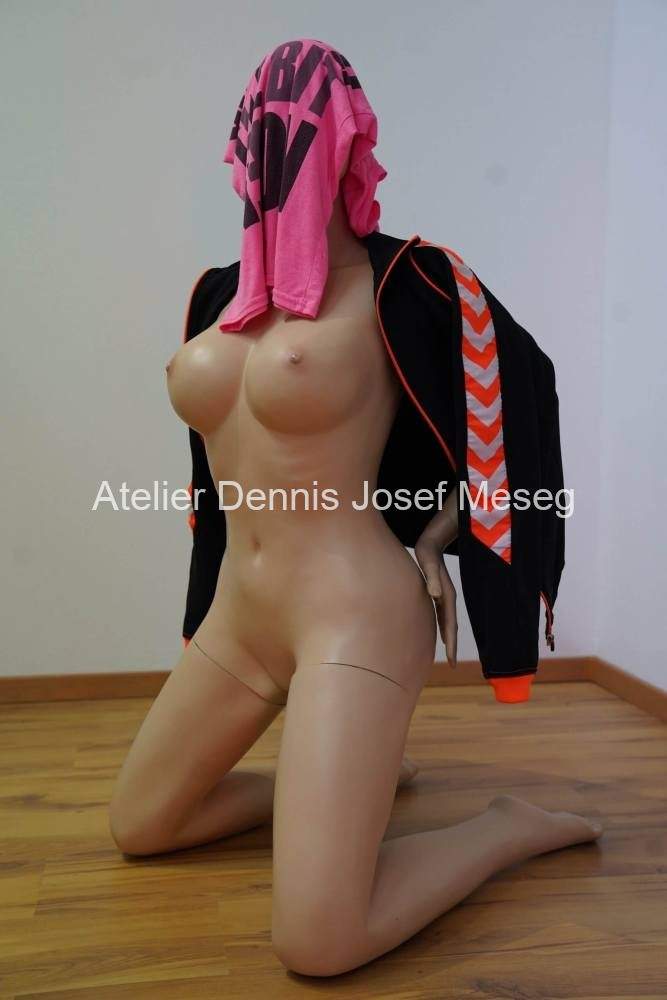
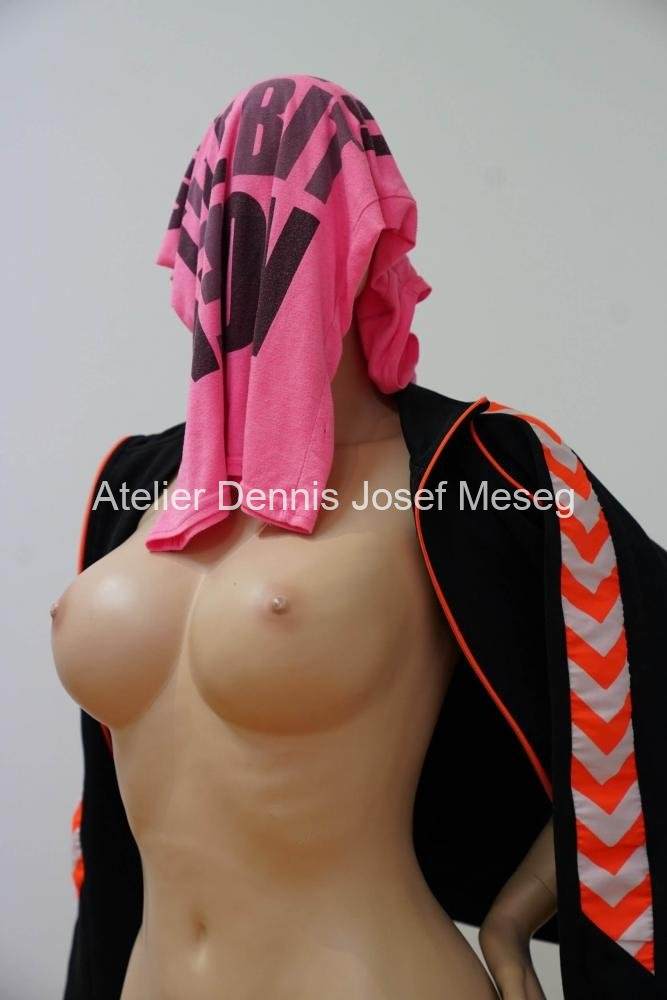
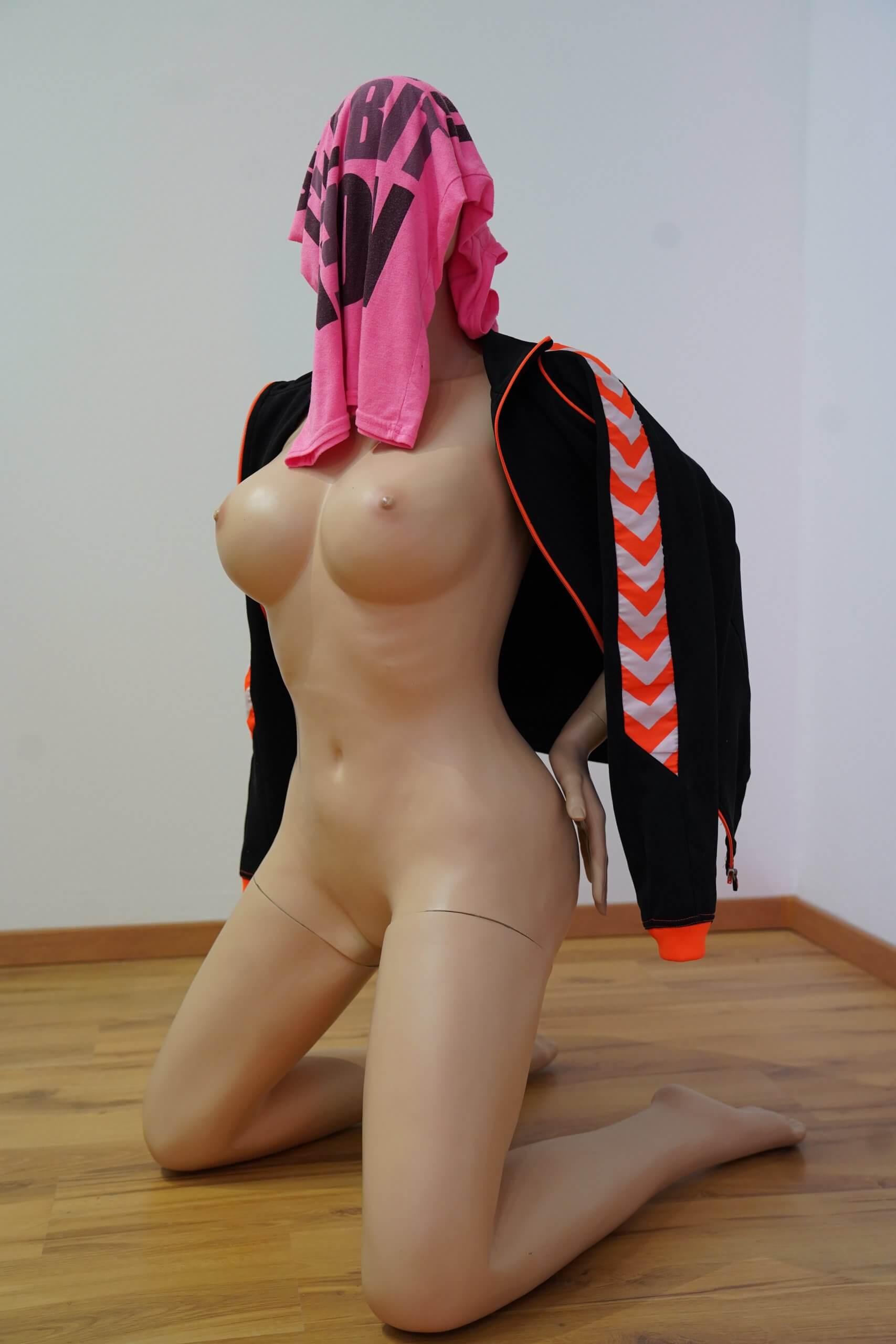
Materials: mannequin, pink T-shirt, black jacket with neon stripes
Size: approx. 110 cm

She kneels there, accusingly. She wants to show herself to the world. Completely naked and provocative. Yet she wants to remain anonymous. Draped with St. Martin’s mantle, she tries to protect what can no longer be protected. “The land of childhood has burned down.”

Split / Anonymous Exhibitionism – Sculpture – Dennis Josef Meseg – 2021

Neon Script in the Blind Spot

Thesis: The work shows how sexuality in digital capitalism becomes omnipresent while tipping into anonymity and speechlessness. Visibility becomes a pose, intimacy a surface, desire a commodity.

The kneeling mannequin wears the fetish like an advertising sign. The neon noose reading “SEX” does not hang above a shopfront but on the body itself—private space turned into outdoor advertising. This exchange site between inside and outside is the political core of the piece: where publicness is privatized by platforms, desire shifts into display. The pink T-shirt pulled over the head marks shame and protection at once, a low-tech filter that deflects eye contact and still guarantees maximum visibility. The jacket over the shoulder, in the gesture of a shared mantle, evokes care and covering—yet here it remains symbolic; nudity is not abolished, merely framed.

Shop windows are prototypes of algorithmic attention: they promise access without delivering it. The figure kneels—sign of submission? Rather a display posture, an optimized pose in the catalogue of lusts. In this economy, the body’s effect value counts, not its experience. The word “SEX” reads like a brand: it sells what it simultaneously conceals. Thus a paradoxical speech emerges: ever louder, ever less saying. The anonymous overlay—T-shirt, mantle-gesture, mannequin—renders a subject available that need not answer and does not contradict. Convenient—for market, myth, and morals.

Next to the figure, small display cases contain child figures cast in epoxy. They are not sexualized, but they anchor the scene on a second timeline: innocence and archive. Epoxy preserves; it makes objects imperishable, untouchable. In that preservation lies a warning: what culture cannot bring itself to say, it entombs in resin. When society inflates sexualized signs on the one hand and reduces speech, education, and negotiation on the other, silence becomes a form of politics. The internet accelerates this scissor effect: fetishes differentiate, yet discursive spaces narrow—filter bubbles are cozy silos, not forums.

A possible counterposition claims: visibility is liberation; the “SEX” label as self-empowerment, pink as queer appropriation, the pose as ironic citation of consumer aesthetics. But the work refuses to let irony soothe: the illuminated script hangs like a collar. It is jewelry and shackle, statement and coercion to self-marketing. Anonymity—the “mask”—both protects and alienates.

Conclusion: The work exposes the knot where desire, platform logic, and loss of speech tangle. It offers no solution and rejects moralism. Instead, it compels us to recognize advertising as a chain—and to ask how a shared discourse on sexuality might look that is more than glow and click.


User Manual for Adult Mannequins

Welcome to the latest innovation in the department store of feelings: wearable illuminated signage, model “Necklace of Consent™.” Just hang it on, switch to “SEX,” and your profile picture is ready. The pink T-shirt over the head? A GDPR-compliant gaze shield—data protection for faces. And the jacket over the shoulder generously cites St. Martin: sharing is the new covering, just without the hassle of covering.

The figure kneels. Not in reverence, but for the algorithm: knees down, reach up. Visibility isn’t a human right; it’s a pose. Whoever talks, loses—silence is premium content. Hence the epoxy child figures: childhood, but freeze-dried, please. Take-away nostalgia, guaranteed low in discourse.

In the art world, the accompanying statement goes: “Society is becoming ever more sexual, yet talks ever less about it.” Wonderful! At last, a work that brings the comment section into the exhibition—only without comments. The neon noose around the neck? A jewel that says: I’m free enough to choose my own chain. And whoever truly wants to be free stays anonymous. Preferably under a T-shirt. Pink keeps it fresh, almost like Taboo Light.

In a world where everyone is their own advertising tower, illuminated scripts are the new prayers. And: if you don’t want to say anything, say it in capital letters. Conclusion: this work delivers what the market demands—longing with shock absorbers, critique with a dimmer, sex with a silence mode. I’ll buy it. Anonymously, of course.


Silence in Neon

Knees in dust.
Around the neck: a word that glows.
SEX—warm, cold, both.

A T-shirt over the head,
a pink tent of cloth.
Looks glance off, cling to the edges.

A jacket, half a mantle—
pretends to warm.
The skin says nothing.

Beside it, cases:
small bodies, laid to rest in resin.
Time without breath, translucently heavy.

The signage hums,
like a kitchen lamp at night.
You can hear the silence growing.

Who watches?
Who speaks?
Who carries whom here?


Masks of Light, Masks of Shame

Guiding question: What happens to desire when its signs shine brighter than its voice?

The posture of the figure—kneeling, yet not praying—opens a field between ritual and display. The knee is the oldest gesture of supplication; in the shop window it becomes a choreography of the gaze. Around the neck lies an illuminated script whose message has no addressee: “SEX” is not a you, but an echo. It calls to no one; it switches on. The subject wears its own exclamation point like a chain—both ornament and rein. Neon is unnatural daylight: it renders visible what it de-realizes. The body is contoured but not heard.

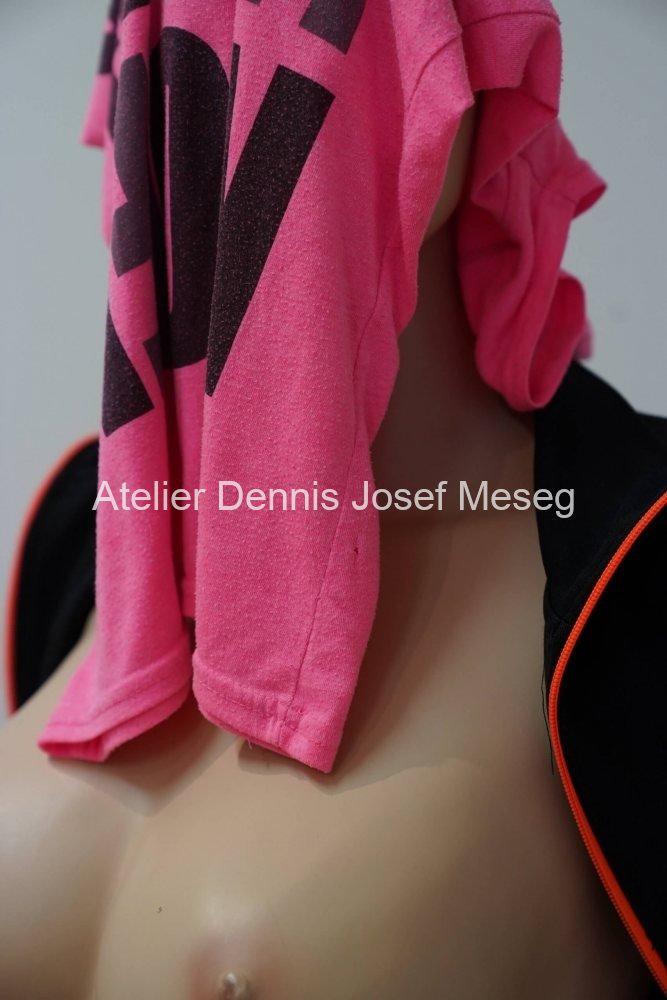
A pink T-shirt rests over the head. The color screams; the gesture falls silent. A mask—improvised, inexpensive, effective. It refuses the face, the place where answerability begins. Anonymity appears here not as back room but as stage: one shows that one is hiding. This paradoxical transparency—openly disguised—fits the logic of an internet that demands revelation while liquefying identity. The mantle gesture over the shoulder summons an ethos of sharing; but the sharing remains symbolic. The body stays exposed; the care remains a pose. Ethics appears as silhouette.

The small display cases with child figures encased in epoxy are time capsules. They recall that subjectivity once did not have to be on display, but could become. Resin preserves, but it also preserves the incapacity to negotiate: what is not discussed gets poured. Thus arises an archive of the unspoken. No scandal, but sediment. The material thinks: it hardens what culture jams.

Within this constellation, shame unfolds as a double movement. On the one hand, it protects—the T-shirt guards the visual field of the face. On the other, it stabilizes the spectacle’s economy: the more is hidden, the brighter the sign at the neck must shine. The mask is not the counterimage of advertising; it is its amplifier. The fetish—as object, image, gesture—thrives in silence; it needs the blank space where meaning is not negotiated. Hence the pose seems not aggressive but still: it waits for projections.

Perhaps the work’s quiet provocation lies precisely in refusing to simulate discourse. No explanatory text, no moralizing finger resolves the tension. The figure remains a possibility: a body that speaks by withdrawing the face; a sign that glows without saying where to. The viewer becomes a co-author—responsible for what they choose to see in it, and for what they choose to leave unsaid.

Conclusion: Between neon and resin, between mantle gesture and T-shirt, a space of slow questions opens. Not: what is allowed? Rather: how can we speak of sexuality without hawking it; how can we wear masks without surrendering tongues? The work does not answer. It merely dims the light so that one can hear one’s own silence.

    Wenn Sie Interesse an einer bestimmten Arbeit haben, dann können Sie hier wegen Verfügbarkeit und Preis anfragen.

    Schreiben Sie einen Kommentar

    Ihre E-Mail-Adresse wird nicht veröffentlicht. Erforderliche Felder sind mit * gekennzeichnet